Resources on the move
If we are serious about creating a sustainable society, we need to use the materials we already have, over and over again. Through technological innovation and collaboration across the value chain, we ensure valuable resources never stand still.
25 Aug 2026Every day, we humans use vast quantities of raw materials. In 2025 alone, the world’s population consumed an astonishing 100 billion tonnes. This constant quest for new resources has devastating consequences. Currently, over half of the world’s climate emissions are caused by the continuous extraction and processing of new raw materials and according to the United Nations Peacekeeping, natural resources have been linked to at least 40 percent of intrastate conflicts in the last 60 years.
To create a safer and more sustainable society, we need to move away from the linear economy and instead turn to circular solutions to meet the world’s growing demand for resources. This means embracing waste as our primary source of raw materials and reusing the resources we have already produced, as many times as possible.
In a truly circular society, resources are always on the move. What you consider to be waste becomes a valuable asset to someone else. The residues of one production process are turned into raw materials for another. By keeping resources in motion, we can ensure that as little as possible is wasted or left unused.
At Ragn-Sells, we are committed to helping create a circular ecosystem. We are developing methods to recover phosphorus from fish poop and turn fly ash from waste incineration into road salt and fertiliser. We give old solvents a new lease of life and prevent old windows from ending up in landfills by recycling old windows into cullets that can be used into the production of new flat glass.
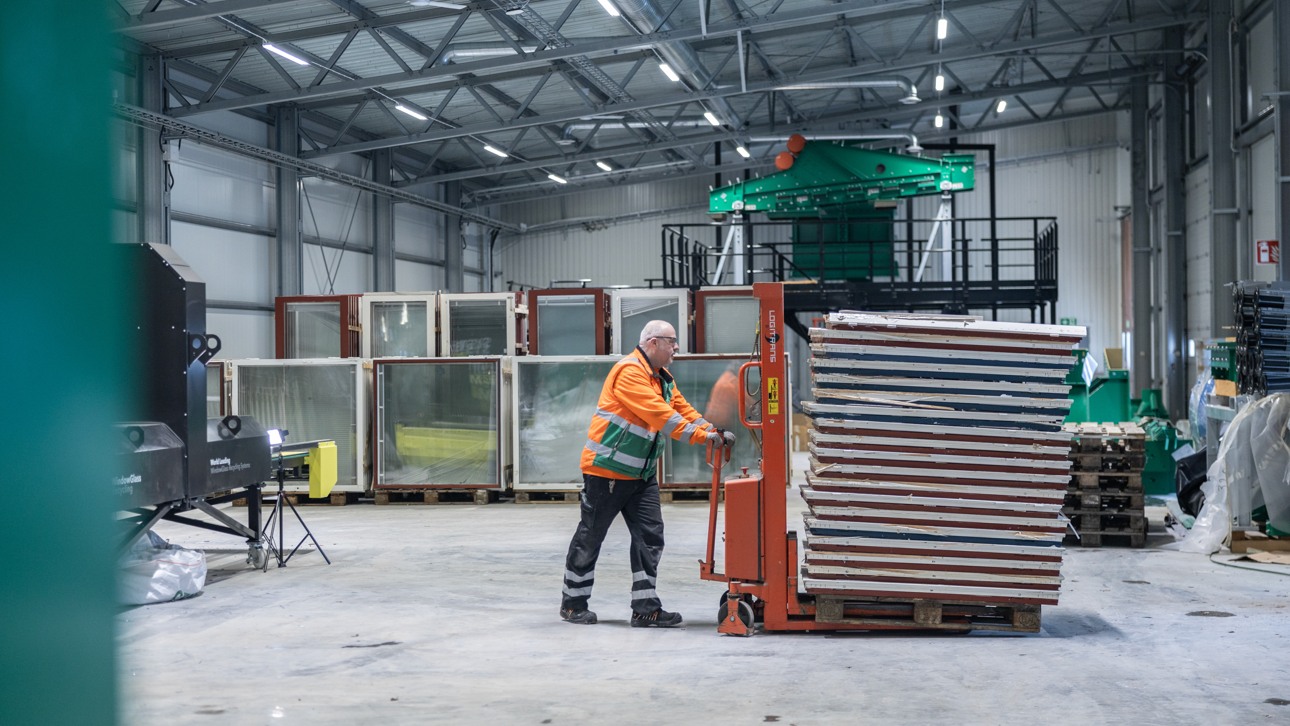 Recycling of flat glass in Ragn-Sells' facility in Örbebro, Sweden.
This is not a one-person job. To ensure that valuable resources are reused, we collaborate with partners across the entire value chain. We work with upstream producers who have residues that can be recycled. We team up with researchers and businesses to develop the technology needed to convert waste into high-quality materials. And finally, we supply downstream customers looking for sustainably produced materials that do not deplete the Earth’s resources.
In addition to innovation and partnerships, the shift to a circular economy requires patience and dedication. Since most products are not yet designed with circularity in mind, achieving a fully circular economy will take time. To accelerate the circular transition, regulatory obstacles also need to be removed, which is why we are working to influence policy in this area.
Furthermore, new harmful substances are introduced into society every day. Even if the inflow of these substances stopped tomorrow, it would take many decades to eliminate all toxins. Although we are continuously developing new detoxification methods, incineration and landfilling will still be necessary to handle waste that is currently too toxic to recycle.
In 2025, Ragn-Sells processed over five million tonnes of material. That is more than five million tonnes either put to new use in various ways or safely disposed of to protect people and the environment. Going forward, we are determined to continue increasing that number.
Why recycle flat glass?
Flat glass is used throughout society, from windows and vehicles to solar panels and screens. Producing new flat glass requires large amounts of energy and high-quality silica sand, a finite resource.
Today, most discarded flat glass ends up in landfill. In Sweden alone, around 35,000 tonnes are landfilled every year. To change this, Ragn-Sells collects and processes old flat glass, which is transformed into a high-quality recycled raw material (cullet) and supplied to Saint-Gobain for the production of new flat glass.
By recycling flat glass into cullet, we can potentially avoid 71% of the emissions associated with an equivalent amount of virgin raw material, while conserving valuable resources and helping secure future access to flat glass.
To increase recycling rates, Ragn-Sells works closely with property owners and other stakeholders to ensure that glass waste is properly sorted and collected, enabling it to remain in circulation rather than being discarded.