At Future Day 2026, circularity gets ‘concrete’
This year’s version of the Ragn-Sells-hosted conference focused on the grounded reality of circular transformation.
27 Oct 2026In the modern conference space of a converted barn about 40 kilometres north of central Stockholm, stakeholders and partners in recycling and environmental issues gathered to talk about circularity on a Friday in early October. But in a way that prioritised the tangible and the real.
The Ragn-Sells’ Sätra Gård facility is a historic farm now used as a meeting and convention venue that’s right next to the Högbytorp waste treatment centre. It’s where the company hosts major events like Future Day (Framtidsdagen), an annual half-day conference co-organised with Ragnar Sellberg’s Foundation (Ragnar Sellbergs stiftelse) that showcases the latest trends, insights, and innovations regarding resource recovery and circularity.
According to Pär Larshans, Chief Sustainability Officer at Ragn-Sells and the event’s official moderator, Future Day 2026 aimed to look beyond the usual connection to climate change.
“This year's focus was much more about global food production,” Larshans said in an interview. “Circularity is not just an environmental topic. It's a resource topic, and it's a future growth topic.”
The programme of speakers and presentations was also centred on practical details, highlighting current resource recycling efforts, gaps in legislative support from the European Union, and definitive ideas to drive circular transformation.
The practicality of the circular transition
The roughly three hours of presentations and discussions kicked off with an introduction by Larshans that stressed increasing pressure on societal resources from environmental and global challenges.
Throughout the day, phosphorus was cited as a key example of such a strained resource. As Prof. Magnus Ericsson of Luleå University of Technology and RMG Consulting explained in his presentation, “Phosphorus as a strategic resource in the circular economy,” the nutrient is essential for human life and a critical agricultural additive. Yet Europe still relies mostly on imports from geopolitically unstable regions, which creates an opportunity for circular solutions that can recycle phosphorus.
Speaking during a break afterwards, Ericsson noted that Sweden’s circularity sector has lacked a voice in Europe-wide recycling of raw materials, but initiatives like Future Day are changing that. “I see Ragn-Sells as helping create that voice on the recycling side,” he said. “And I think that's important.”
Methods for ensuring that recycled resources, like phosphorus recovered from waste streams, are safe for wide-societal use were also touched on. Swiss doctoral student Rhayn Werz, whose industrial PhD project is in collaboration between Ragn-Sells and Örebro University, shared their interim findings in a presentation that detailed how combining target chemical analysis with cell-based biological tests can screen for “novel entities” (like phthalates, microplastics, and PFAS) across sewage sludge, bio-fertilisers, and manure.
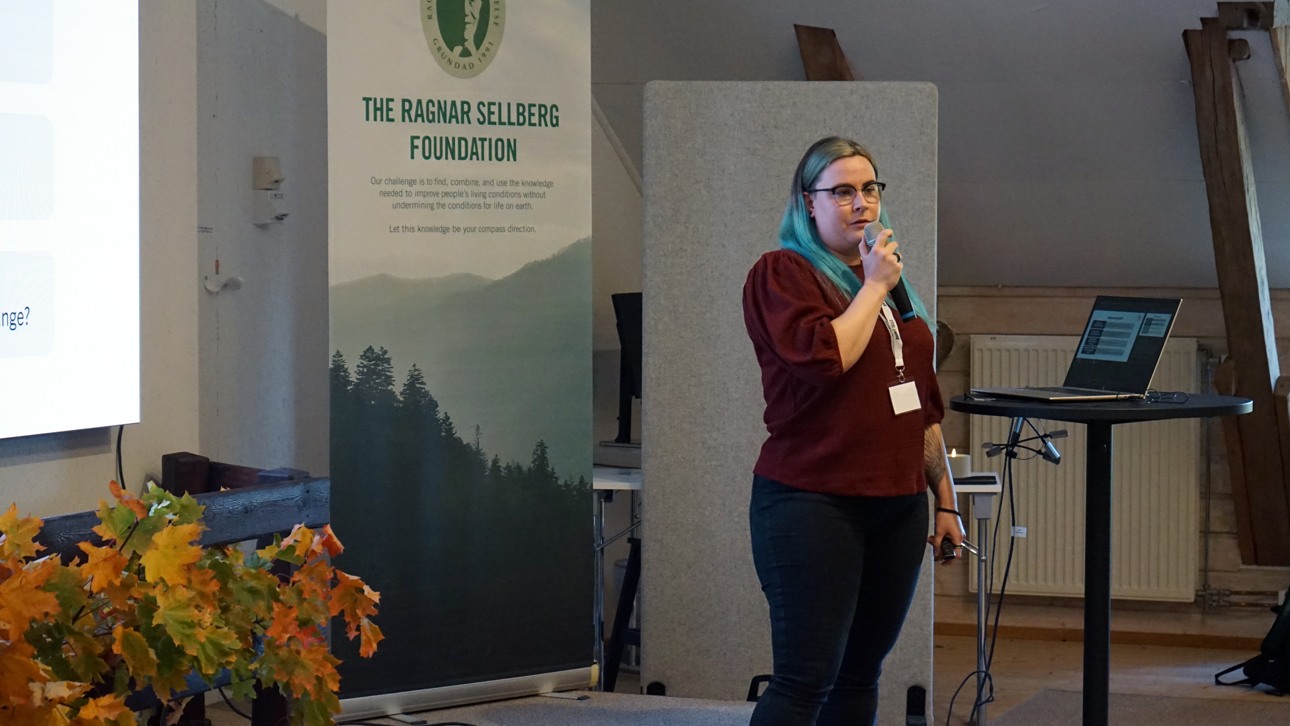 Rhayn Werz, doctoral student from Switzerland.
Werz explained later that their work had reached a point that showed real progress in the research. “The challenge is to really find the balance in communicating in an easier-to-understand way but still maintaining the scientific level,” Werz added.
Closed loops and uneven playing fields
The overarching theme of closing the loop for phosphorus continued into definitive examples of large-scale circularity. Two key projects were front and centre: the soon-to-be completed Ash2Phos plant in Schkopau, Germany (which utilises a process for reclaiming phosphorus from incinerated sewage sludge developed by Ragn-Sells subsidiary EasyMining) and the EU-funded AQUAPHOENIX effort in Norway (which features Ragn-Sells Havbruk among its partners in researching fish sludge from aquaculture as a source for recycled phosphorus).
Ole Arthur Vaage, CEO of Ragn-Sells Havbruk, gave a full update on the AQUAPHOENIX Project, including its potential for turning waste from Norwegian salmon farming into bioenergy and phosphorus fertilisers. Meanwhile, John Svärd, Head of Engineering and Plant Sales for EasyMining, detailed the realities of implementing new technology like Ash2Phos at an industrial scale for the first time.
According to Svärd, sharing such project updates is critical for overall progress. “It's very important to communicate what we are doing and what phase we are in, to show that something is actually happening in the area of phosphorus recovery,” he said.
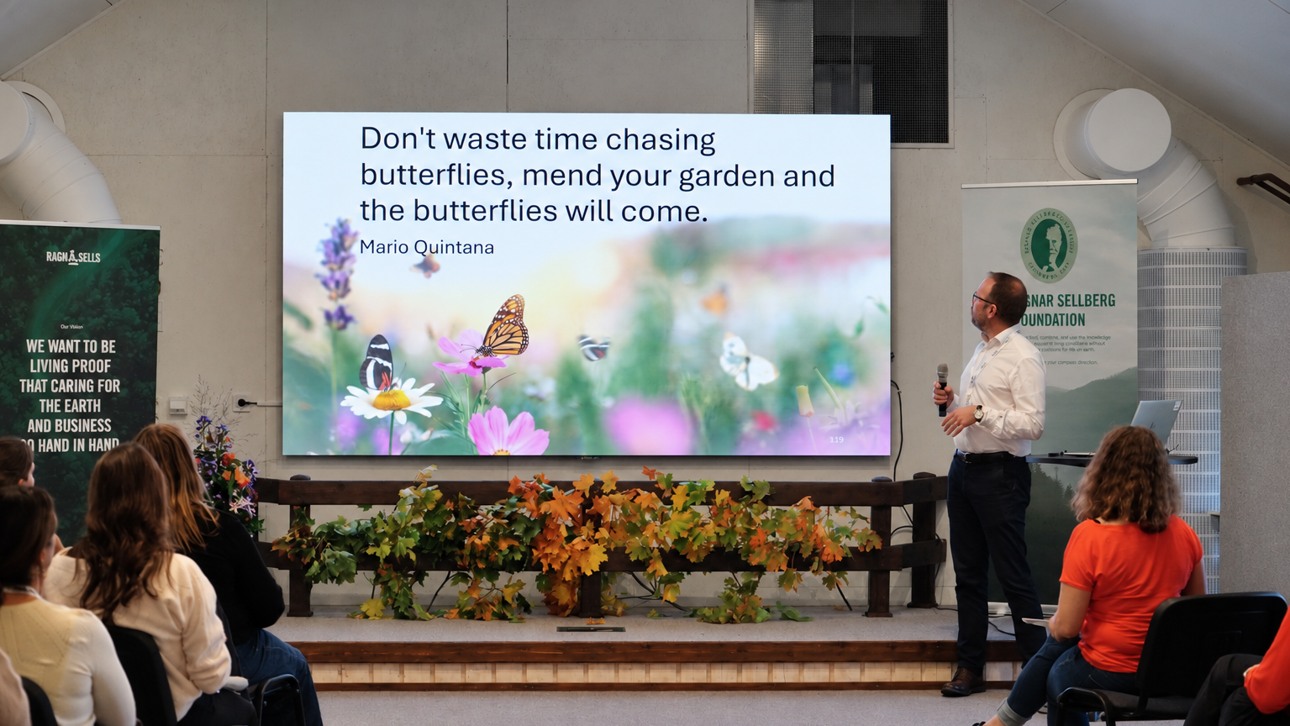 Karl Edsjö, Sustainability Strategist at the corporate consultancy Cirkelar.
However, the biggest obstacle slowing down the circular transition is the lack of government policy support. As Karl Edsjö, Sustainability Strategist at the corporate consultancy Cirkelar, highlighted in his presentation “Should legislation be designed based on planetary boundaries?”, most EU regulations focus downstream in value chains rather than upstream, where materials enter. They also fail to address the disadvantages of business models based on the circular economy.
“We need to create a level playing field,” said Edsjö. “The linear model has a built-in discount. It is much cheaper to operate linearly. Raw materials aren’t free, but virgin raw materials are usually cheaper. When they are cheaper, a circular solution finds it very difficult to compete.”
“We're trying to combine circularity with concrete examples of how it can be used”
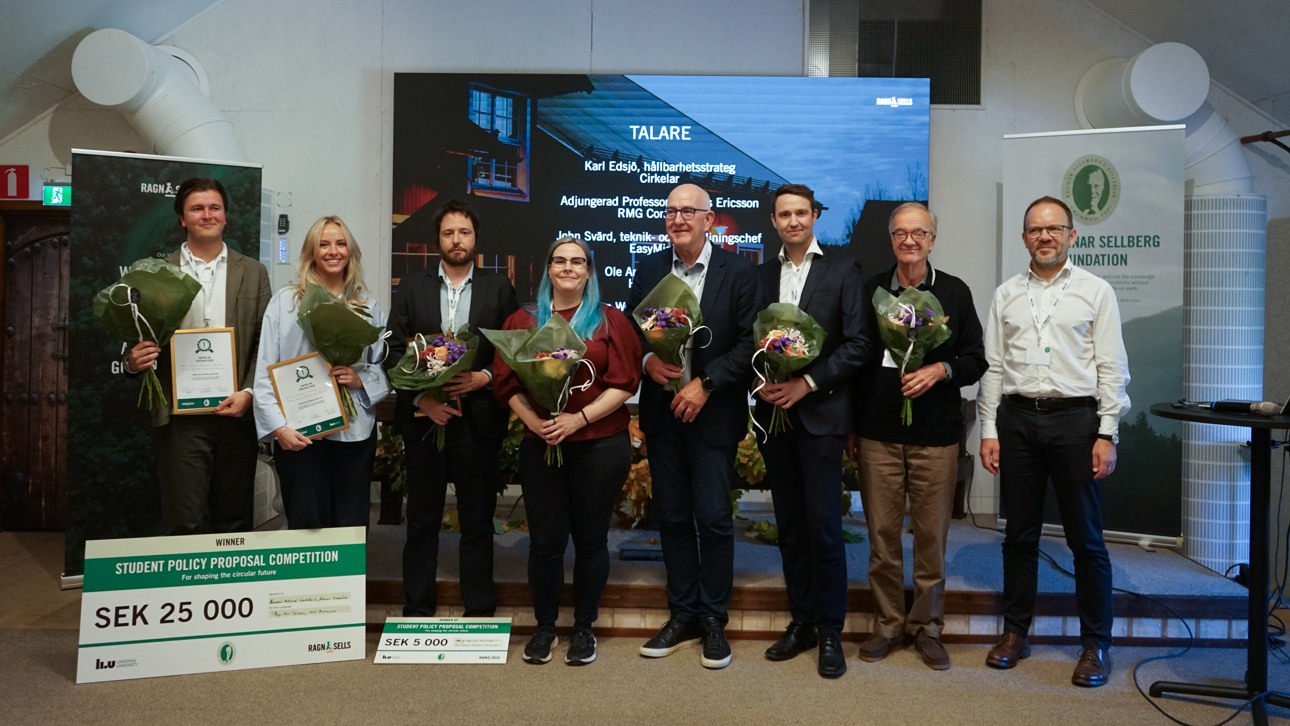
A major part of Future Day 2026 was the Ragnar Sellberg Foundation’s Student Policy Proposal Competition. Co-sponsored by Ragn-Sells and Linköping University, the contest invited university students to submit actionable policy proposals and practical frameworks to bridge market gaps in circularity.
The top three finalists presented their proposals to the audience, including the pilot programme of a credit-and-verification system for recycled phosphorus and a framework for reusable building materials using digital pre-demolition audits and a central marketplace. It was the last stage for the competition’s jury to consider before announcing the winner as the event drew to a close.
In the end, Linköping University graduate students Hampus Ardland Looström and Johanna Lindbäck won for their proposal outlining a state-guaranteed tender price model to de-risk plastic recycling infrastructure investments.
“The conversations we had afterwards were what really stood out to me,” Ardland Looström said about the experience. “Getting questions from people in the sector, who deal with these issues every day, was really valuable.”
Ultimately, the event continued on Future Day's underlying principle of sharing insights that help move the circular transformation forward.
“We're trying to combine circularity with concrete examples of how it can be used,” said Larshans. “We need to be concrete. Otherwise, nobody will listen.”