Interview with EU Minister Jessica Rosencrantz
Watch the video interview
Europe’s dependence on imported phosphorus can be reduced by enabling circular solutions already available at scale. During a visit to EasyMining and Ragn-Sells in Uppsala, Sweden’s Minister for EU Affairs highlighted the need to update EU rules that currently block the use of recycled phosphorus in animal feed.
11 May 2026Europe relies heavily on imported phosphorus – a critical nutrient for both fertilisers and animal feed. Today, the EU imports the majority of its phosphorus, mainly from Russia and Morocco, while domestic production covers only a small share of demand.
– Europe faces a dual challenge: we need to create better conditions for companies to scale innovation, while ensuring that legislation supports sustainability and environmental protection. This is where companies like Ragn-Sells play an important role, said Sweden’s Minister for EU Affairs Jessica Rosencrantz during the visit.
Phosphorus is essential for food production. Without it, agricultural output declines. At the same time, large volumes of phosphorus are currently lost in waste streams across Europe.
– When it comes to Russia, we should reduce our dependence in every possible way. If we can do that through circular technologies, such as those we have seen here today, it creates both environmental and security benefits for Europe, Rosencrantz said.
A regulatory barrier to circularity
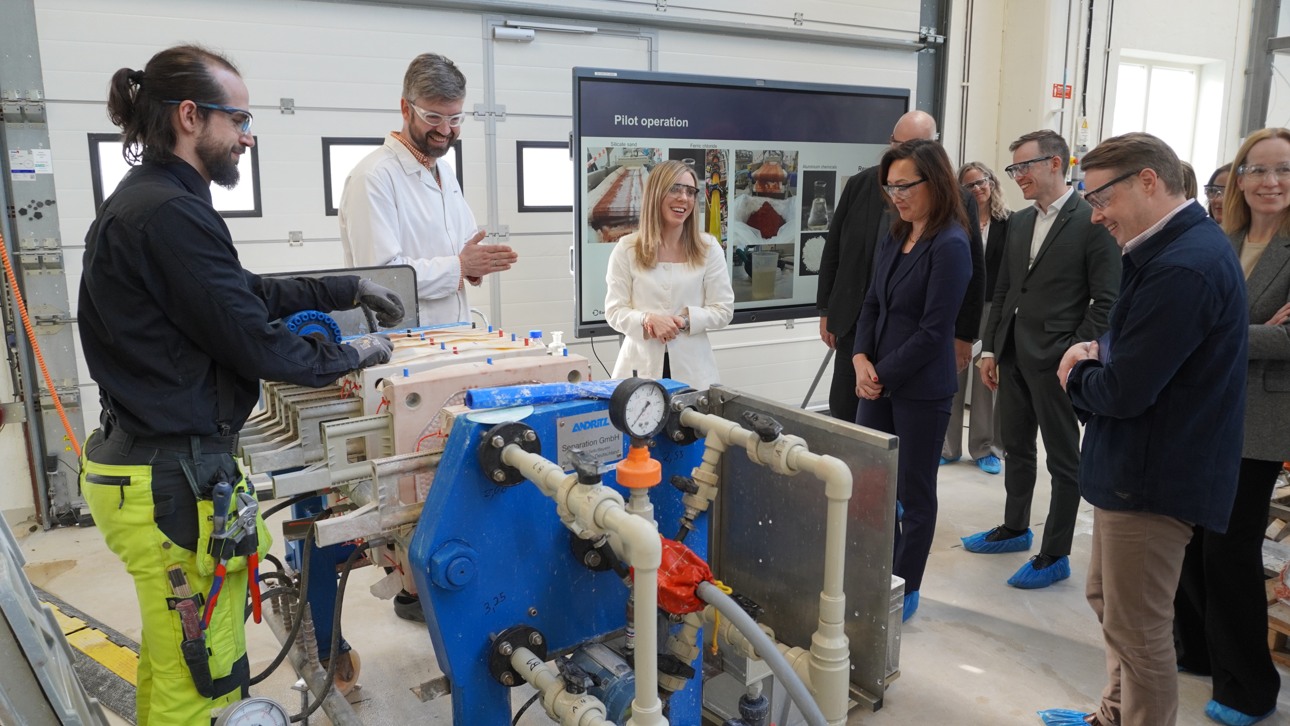
Ragn-Sells’ innovation company EasyMining has developed the Ash2Phos process, which can recover more than 90 percent of the phosphorus from sewage sludge ash. Two large-scale plants are currently under construction in Germany and Sweden, demonstrating that industrial-scale recycling is already feasible.
However, a key regulatory barrier remains. While recycled phosphorus is approved for use in fertilisers – including organic farming – it is still prohibited in animal feed under EU legislation. The restriction originates from rules introduced after the BSE crisis and applies regardless of the purity or safety of the recovered material.
– There is a clear opportunity to reuse resources and create more circular flows. Where this is possible, legislation needs to enable it – for example when it comes to using recycled phosphorus in animal feed, Rosencrantz said.
The Swedish government has therefore called on the European Commission to review existing legislation and consider updated risk assessments, with the aim of enabling safe use of recycled phosphorus in additional applications.
– In many cases, the issue is not unwillingness, but rather outdated rules or lack of awareness. This is why we believe it is important to push the Commission to act. That is why Sweden has submitted a concrete proposal for regulatory simplification in this area, Rosencrantz said.
A broader European opportunity
The issue is expected to become part of upcoming discussions on the EU’s Circular Economy Act. The Swedish government has emphasised the need to remove regulatory barriers that hinder innovative recycling solutions.
At the same time, similar challenges can be observed beyond wastewater. During the visit, the minister was also presented with technology for capturing nutrients from aquaculture waste, currently being tested in Norway.
Recent decisions by Norwegian authorities to halt further expansion of fish farming in parts of Hardangerfjord highlight the environmental constraints linked to nutrient emissions. At the same time, these nutrient flows represent a potential resource if captured and recycled.
– This is a clear example of Swedish innovation in practice, Rosencrantz said.
According to Ragn-Sells, enabling the use of recycled phosphorus in feed would not only reduce import dependence, but also support the development of a new circular industry in Europe.
– The current ban is a clear example of how outdated legislation can hinder circular solutions. With the upcoming Circular Economy Act, the EU has an opportunity to remove unnecessary barriers and strengthen both competitiveness and resilience, said Pär Larshans, Chief Sustainability Officer at Ragn-Sells Group.
Further reading: https://www.ragnsells.com/circular-transition/think-circular/foodsecurity/
Watch the video interview