Student proposal could unlock investment in plastic recycling
How can Sweden make plastic recycling economically viable? That question earned Linköping University students Hampus Ardland Looström and Johanna Lindbäck first prize in the 2026 Student Policy Proposal Competition, organised by the Ragnar Sellberg Foundation and Ragn-Sells.
30 Oct 2026The future depends on circularity. Replacing the wastefulness of the traditional linear economy with closed loops of recovery and reuse is key to addressing environmental challenges and overcoming the growing scarcity of resources critical for society to carry on.
But while the transition to a circular economy is gaining momentum, resource use remains unsustainable. Bridging the gap between circularity’s ambitions and its results requires new ideas for policies and initiatives.
Ideas like the approach put forward by Linköping University graduate students Hampus Ardland Looström and Johanna Lindbäck in “Pay for tonnes, not promises”, which won the 2026 Student Policy Proposal Competition for Shaping the Circular Future. The duo were announced the winners and awarded a SEK 25,000 cash prize on October 2 at Future Day (Framtidsdagen), an annual half-day conference on resource recovery and circularity, after they had presented their proposal alongside two other finalists.
“I don't think either of us expected it. We were just so happy to be there,” says Lindbäck.
Plastic resources going to waste
Like Future Day, the policy proposal competition is co-organised by the Ragnar Sellberg Foundation and Ragn-Sells. But unlike the former, it’s also in collaboration with Linköping University. The competition invites university students from Sweden and abroad to submit “a well-founded policy proposal that presents one clear and actionable measure to support a more circular and sustainable society.”
For Ardland Looström and Lindbäck, that means removing risk from investing in Sweden’s plastic recycling infrastructure. “The basis of our proposal is that plastic recycling isn't mainly a technology problem. It's a financing problem,” says Ardland Looström.
Both Ardland Looström and Lindbäck are currently pursuing master's degrees in engineering at Linköping. Ardland Looström’s concentration is energy, environment and management, while Lindbäck's is design and product development. The two also hail from the Swedish city of Örebro which is how they know each other.
When the policy proposal competition was announced in early summer of 2026, it created an opportunity to combine their disciplines. Ardland Looström focused on the analysis and the financials side of the proposal, while Lindbäck streamlined concepts and strengthened how they were communicated.
The result is a proposal that highlights the serious disconnect between intent and outcome for plastic recycling in Sweden. Despite the country’s incredible collection rates for recyclables, with most of the public separating plastic waste for recycling, the majority of what’s collected isn’t recycled.
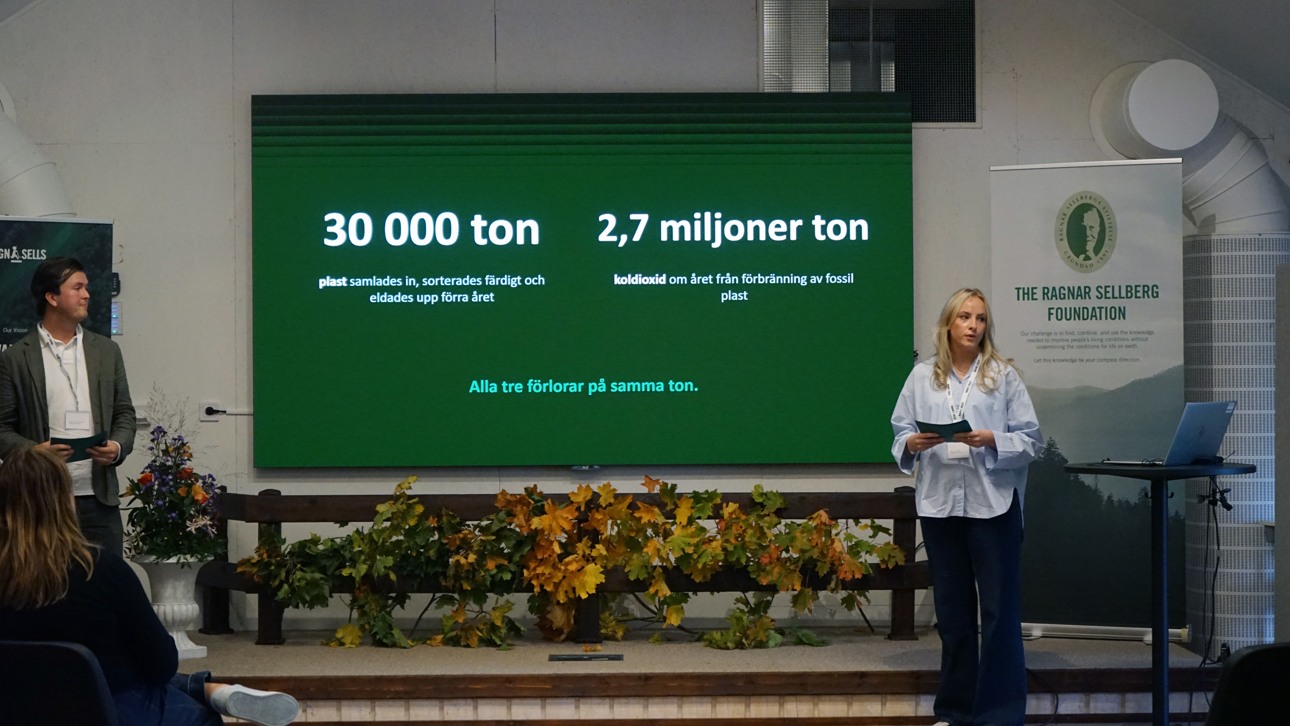
Around 70% of plastic packaging waste is incinerated, releasing over 2.5 million tonnes of CO2 every year.
“We pay to fail right now”
Revenue from plastic recycling fluctuates with oil prices, creating market volatility that leaves recyclers unable to get financing to build plants and driving them into insolvency. As a result, Sweden can't recycle all the plastic it collects. Around 70% of plastic packaging waste is incinerated, releasing over 2.5 million tonnes of CO2 every year and costing Sweden SEK 9,000 per tonne in EU penalties.
What’s more, EU regulations requiring recycled content in plastic packaging will go into effect in 2030 and drive up demand for recycled plastic.
“That was a bit mind-blowing to me,” says Lindbäck. “We have lost about 1 million tons of capacity, which is going to be a real problem in 2030 when everybody is going to be screaming for recycled plastic.”
To address this, Ardland Looström and Lindbäck propose reallocating money Sweden currently pays in EU non-recycled plastic penalties towards recycling facilities.
“We pay to fail right now. The same ton of plastic that gets burned damages the climate. Recyclers can't get profit from it, and the state pays a fee to the EU for it,” says Ardland Looström. “If we can move the money for some of those fees to the recycler so they can get profit, then we can make everything better.”
The proposed policy outlines a framework of tenders for government contracts, where recyclers bid to receive a guaranteed rate per tonne of recycled plastic for 10 years. If market prices fall below the rate, the state covers the difference. If market prices exceed the rate, the company pays back the surplus. Properly implementing the policy, however, will require EU approval and enough recycling companies to bid.
Starting with a real problem
A major reason for connecting the policy proposal competition and Future Day is to bring together circularity's next generation with current industry stakeholders and policymakers.
“It was kind of nerve-wracking to present this idea to people who work with these questions every day,” says Lindbäck. “But that’s also what made it such a great experience: to get to test the idea on people who actually know the industry.”
Despite that, Ardland Looström and Lindbäck advise students planning to enter next year’s competition to refine their proposal pitch and presentation so even people unfamiliar with the topic can grasp it, no matter how complex it is.
“For the public to accept a proposal, it needs to be simple. If you can't explain it to a friend over a coffee, then you need to keep working on it,” says Lindbäck.
They also offer solid advice for getting to the bottom of circularity issues where achievements fall short of aspirations.
“You need to start from a problem, real problem,” says Ardland Looström. “Then follow the money somehow. And find out why nobody is fixing it.”